Students who are the first in their family to attend college have more difficulties in going to college, since they don’t have the benefit of family members’ college experience. However, it is their determination in going to college that helps them overcome those barriers.
This Sunday, Nov. 8, marks the 10th annual First-Generation College Student Day, a day designated by the Council for Opportunity in Education to honor the achievements of first-generation college students and raise awareness about their challenges.
A first-generation college student is defined as someone whose parents did not complete a four-year college or university degree.
One example of a first-generation college student is Dr. Yancy Freeman Sr., the chancellor of the University of Tennessee at Martin. Freeman is the sixth of eight children, and although two of his older brothers went to college, they did not graduate.
“I think I knew in middle school that I wanted to go to college,” he said. “My mom had a 10th-grade education, so she didn’t graduate from high school. I told my mom that I wanted to go to college. I didn’t know where I wanted to go, but I knew I wanted to go.
“Despite not having a high school diploma or a degree, she put me in places where I could be exposed to people who have the same sort of desires. I went to a public school in Memphis – it was a college prep public school. It was a very good high school, with several National Merit Scholarship finalists. That helped to set it up for me, to have the expectation that I was going to go.
“I didn’t know how I was going to go to college because we didn’t have any money; there was no way for my mom to pay for me to go to college. Back then, it was $650 a semester, but it might as well have been a million dollars because we didn’t have the $650.”
Freeman took advantage of financial aid, student loans and scholarships to piece together a payment plan that enabled him to attend the University of Tennessee at Chattanooga. He also sat down with his mother to discuss what he needed or figure out what the application was asking for.
Freeman said that first-generation college students often go through “sticker shock” when applying to go to college.
“When we say to someone, ‘$24,000 a year,’ what you don’t see on the other side of that are ways that we have for you to be able to pay for it,” he said. “You don’t see the Lottery Scholarship or Pell Grant dollars or UT Promise funding. There are more ways to get around that cost that can make it more affordable than students know.
“They may look at the cost and say, ‘Oh, I can’t afford to do this,’ and that is just not true anymore. It may be less true now than it has ever been.”
UT Martin offers several opportunities and programs to help first-generation college students attain their dream of a college degree and working in a field that suits their skills and interests.
Freeman said there are several scholarships that are merit-based, need-based or based on things like a student’s hometown or their parents’ occupation or organizations they belong to – and many of them go unused.
“We try to give them out as much as we can by encouraging students to do the scholarship application for those endowed scholarship awards, but if they don’t do them, then the money just kind of sits there and rolls over,” he said. “We try to push them out as much as we can to try to give scholarship money.
“One of the biggest things that we get donation dollars for is scholarships. You get to see the person and know that it’s going toward a benefit. When you contribute to an endowment scholarship or to a scholarship fund, you know that the money is going to a person, so we’re always out fundraising for scholarships to make it affordable for students.”
A listing of available scholarships at UT Martin can be found at www.utm.edu/scholarships or by contacting the Office of Financial Aid and Scholarships at 731-881-4677 or sending an email to financialaid@utm.edu.
One misconception made by first-generation college students is that they have to know what they want to get a degree in before they come to college.
“I started as an engineering major and ended up in political science,” Freeman said. “College should be about exploration and should be an opportunity for you to not just come and get a degree, but be a chance to get to know people you’ve never met from different parts of the world. It should be a chance for you to learn about something that you are interested in.
“You may say, ‘I want to learn how to do this or that,’ and you have a chance to do that in college, like the
There are several opportunities for students to visit the UT Martin campus and learn about the university’s classes, instructors and degrees that it offers. Along with two Preview Days in the fall and spring semesters, there are opportunities to schedule in-person tours, virtual tours and group tours. All of these options and more can be found at www.utm.edu/visit.
Other events may be scheduled during the year like the Future Skyhawk Roadshows that toured from Knoxville to Memphis, enabling area students to come and ask questions about attending UT Martin. The final stop for the Roadshow for the fall semester will be at 6 p.m., Monday, Nov. 16, at the Boling University Center on the main campus of UT Martin.
Freeman said students can speak with their school counselors or deans of students about attending college. They can also contact the UT Martin Office of Undergraduate Admissions about how to begin the process of getting to college at 731-881-7020 or admissions@utm.edu.
“First-generation college students don’t necessarily have someone at home who has gone through the process who can help them navigate their way through,” Freeman said. “We have such an incredible admissions team of people who really do care about students and will help them from the very first part of the process to the very end of the process, when they get enrolled. Admissions is a great resource for students to be able to know what comes next and can send information in so many different formats.”
Once at UT Martin, there are support groups and organizations for first-generation college students, including the First-Generation Scholars Program and Alpha Alpha Alpha, a national honor society for first-generation college students.
For more information about UT Martin, visit www.utm.edu or call 731-881-7000.
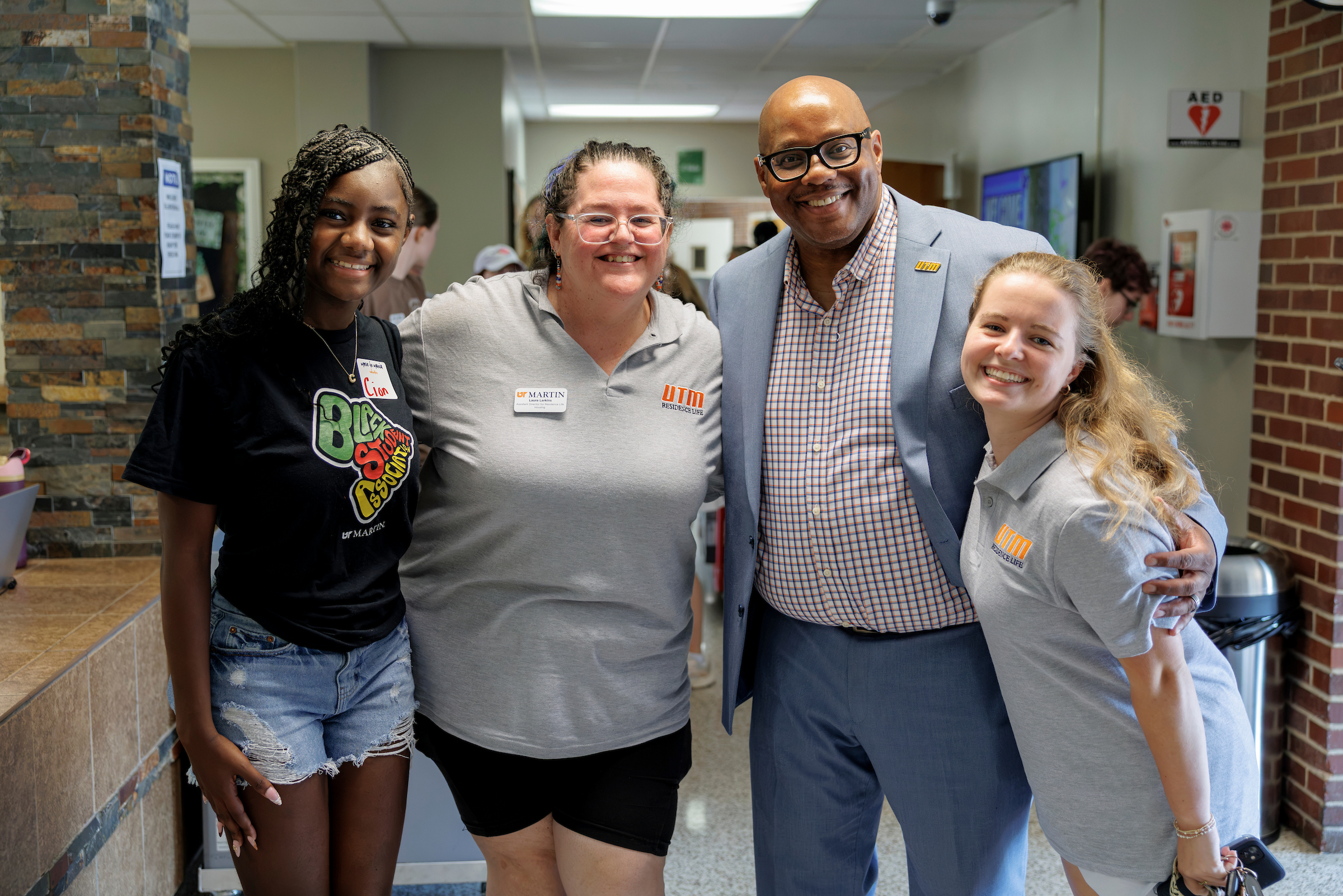
PHOTO: UT Martin Chancellor Yancy Freeman Sr. and Laura Larkins (second from left), assistant director of the Office of Housing, pose with students Cion Osei (far left) and Kayla Street during Move-In Day last August at UT Martin. Freeman is an example of how first-generation college students succeed in college and beyond.