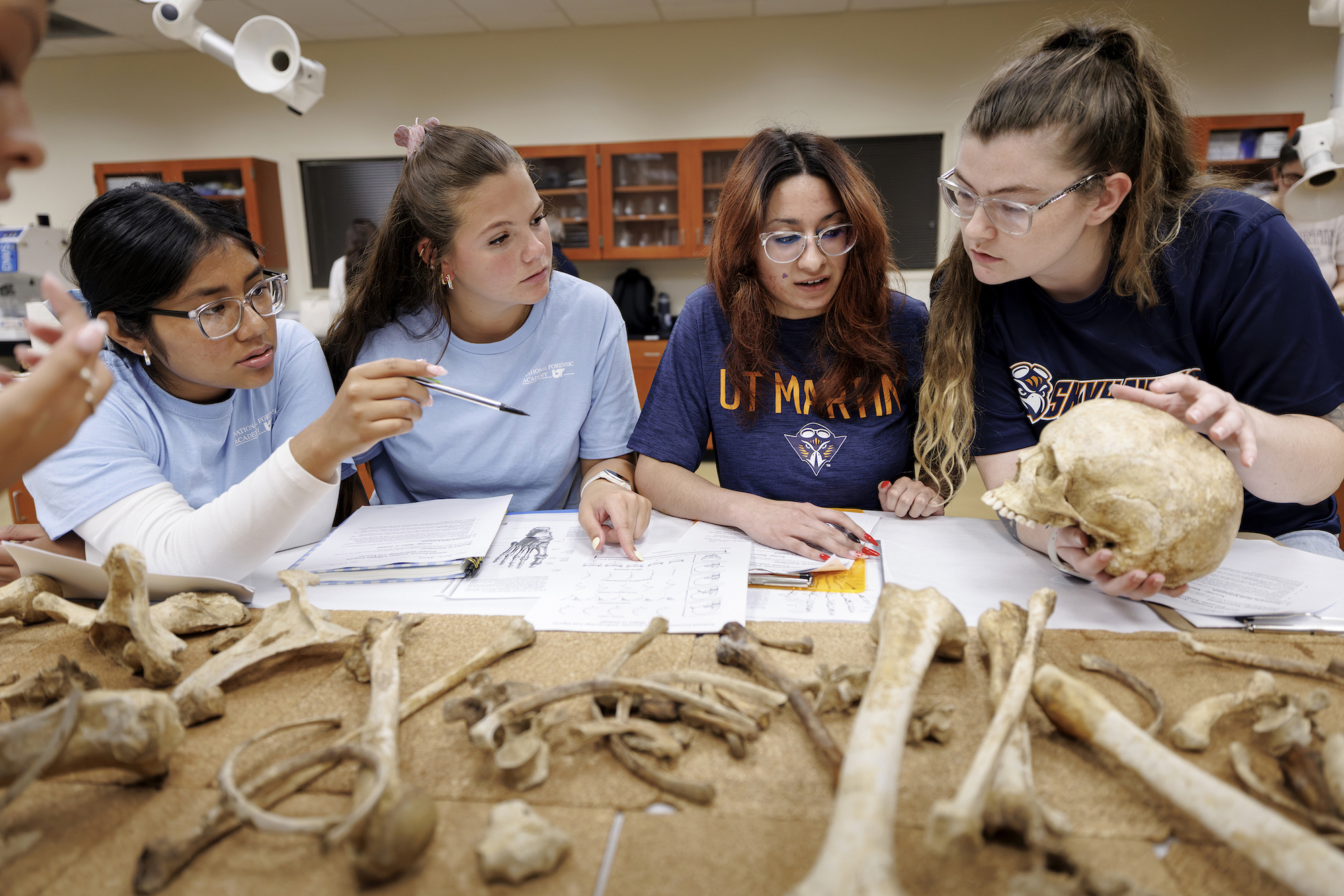
When Harlee Veazey began working with bones during a forensic anthropology exercise at the National Forensic Academy Collegiate Program, she discovered an interest she hadn’t expected.
The UT Martin senior criminal justice major had studied anatomy before, but examining bones, identifying signs of trauma and discussing how investigators determine a person’s cause of death gave her a different perspective.
“I was kind of iffy about that,” Veazey said. “But now, doing this and actually putting everything together and seeing where everything goes, and then also discussing: How did this person die? Where are the blunt force traumas? All that information really interested me.”
The experience was among the highlights of Veazey’s participation in the three-week National Forensic Academy Collegiate Program, held at the University of Tennessee’s Law Enforcement Innovation Center (LEIC) in Oak Ridge.
The academy, offered through a partnership between UT Martin and the LEIC, provides undergraduate criminal justice students with intensive training in crime-scene investigation. The program is modeled after the center’s 10-week National Forensic Academy for law enforcement professionals and allows students to earn nine hours of undergraduate credit.
Students receive instruction in crime scene management, forensic photography, fingerprint processing, forensic anthropology, shooting incident reconstruction, bloodstain pattern analysis and other investigative techniques. The training combines classroom instruction with practical exercises designed to help students apply what they learn.
The partnership between UT Martin and the LEIC dates to 2012, when then-UT Martin criminal justice professor Dr. Brian Donavant and former LEIC Executive Director Don Green helped establish the collegiate program. According to Dr. Cindy Boyles, UT Martin associate professor of criminal justice, summer 2026 marked the program’s 15th year. The academy has attracted students from universities across the country.
For Veazey, a Paris native and Henry County High School graduate, the experience reinforced her decision to pursue a career in criminal justice.
After graduating from high school, Veazey attended Berea College in Kentucky, where she played basketball and studied nursing. Although she enjoyed the opportunity to attend college away from home, criminal justice had always interested her. The program wasn’t offered at her previous college, and she eventually decided to transfer to UT Martin.
“I’m so glad I came back to Martin,” she said.
Veazey’s interest in criminal justice developed partly through her mother’s work operating sober living houses. She initially considered pursuing a career involving drug enforcement, but her experiences at UT Martin have introduced her to other possibilities, particularly crime scene investigation.
“I’ve probably watched every crime show you could ever think of,” she said. “…Being here … makes me realize how I want to be on scene.”
At the National Forensic Academy, Veazey was able to explore that interest firsthand. During the program, she learned techniques for photographing crime scenes, collecting fingerprints, examining footwear impressions and analyzing bones.
She said the combination of classroom instruction and practical exercises has been especially valuable.
“It’s definitely a very hands-on, accelerated program,” she said, “so much hands-on that you almost can’t forget what you just talked about in the classroom because you’re immediately getting that experience as well.”
Boyles, who serves as UT Martin’s instructor for the collegiate program, coordinates student participation and works with the LEIC on program logistics. She said the academy is a required component of UT Martin’s forensic science concentration within the criminal justice program.
While traditional criminal justice coursework emphasizes academic foundations such as theory, critical thinking and history, Boyles said the academy allows students to put that knowledge into practice through hands-on training.
“Almost everything at the collegiate program is hands-on,” Boyles said.
Boyles said the partnership also provides students access to experienced instructors from the LEIC and specialists brought in from across the country. Each session accommodates up to 31 students, with about half typically coming from UT Martin and the remainder from other universities throughout the United States.
The academy also gives students an opportunity to explore specialized areas of forensic science that they might not have previously considered. For Veazey, the forensic anthropology exercises opened the door to a possible career interest.
Another part of the academy’s training that captured Veazey’s interest was an outdoor exercise at an off-site location outside of Oak Ridge where students study human decomposition and practice recovering skeletal remains.
“We dug up the bodies, dug up the bones. We got to see [decomposition] live,” Veazey said while describing the exercise. “We work in teams. We analyze the bones. We try our best not to damage the graves or anything like that.”
Veazey also described the challenges of working outdoors in protective suits, but said the experience was worthwhile.
“It is the coolest experience ever,” she said.
Boyles said experiences like these help students discover career interests they might not have considered before attending the academy. Some students leave with a newfound interest in a particular specialty, while others realize that forensic investigation may not be the career they want to pursue.
“I think it also gives them confidence that this is what they want to do,” Boyles said.
Beyond the technical training, Boyles said the academy provides opportunities for students to build professional relationships with instructors and classmates from other universities. Those connections can become valuable as students enter a field where professional networking and specialized training are important.
Veazey plans to graduate in December and pursue a master’s degree at UT Martin. She hopes to begin her career with the Paris Police Department or potentially secure an internship with the Tennessee Bureau of Investigation. Although she hasn’t settled on a specific career, she knows she wants a position that allows her to work directly with investigations.
Wherever her postgraduate path may take her, Veazey credits the personal attention she has received at UT Martin with helping her discover her interests and develop her skills.
She particularly praised Boyles for her hands-on approach to teaching.
“I love, love, love the way she teaches,” Veazey said. “It’s not just you’re sitting there listening to a PowerPoint. You have a physical paper in front of you, you have physical evidence, whatever the case may be in the class.”
For Veazey, the close relationships with faculty and opportunities for practical experience have made UT Martin the right place to pursue her goals.
“Everything is very one-on-one,” she said. “And that’s my favorite part about Martin, for sure, is how one-on-one it is with the teachers. We have smaller classes, so you really get that connection.”
For more information about UT Martin, visit www.utm.edu or call 731-881-7000.
PHOTO: Harlee Veazey (second from left) works with classmates (from left) Belinda Pablo Matias of San Francisco State University and Sydnee Formosa and Morgan Rayburn, both of UT Martin, to assemble a skeleton from a collection of scattered bones during the National Forensic Academy Collegiate Program. The group sorted the bones and assembled the skeleton to estimate the deceased individual’s age at death, sex and ancestry.