In the summer of 1915, a young geologist from Trenton named Bruce Wade discovered a huge fossil site at Coon Creek on the Dave Weeks farm in McNairy County, perhaps Wade’s crowning achievement after years of fossil discoveries throughout southwestern Tennessee in the early part of the 20th century.
A paper written by Wade, “The Fauna of the Ripley Formation on Coon Creek, Tennessee,” was published in 1926 – 100 years ago this year – about many of his findings after several visits to the site, revealing a hidden treasure chest of prehistory to be found there.
The paper listed more than 300 species of animals that he had found at the site through the fossils he discovered, ranging from small seashells to giant mosasaurs.
Wade was actually a geologist – not a paleontologist – and he was more interested in finding Cretaceous Period sediments than fossils. While traveling through Tennessee, people told him about the fossilized finds in the area then known as Fossil Farm, and he decided to give it a look.
“He comes over here and meets Dave Weeks, who was pretty much the first person to actually see the fossils here,” said Joshua Ratliff, the Coon Creek program director and lecturer in the UT Martin Department of Agriculture, Geosciences and Natural Resources. “Weeks moved his homestead here in the 1850s, so he had been here for about 50 years or so already. He was the one who had discovered the fossils.
“When Wade got here, he recognized that it wasn’t a one- or two-fossil find; it was a treasure trove of material that no one had really documented in the scientific community.”
Today, the Coon Creek Science Center remains a place of discovery and scientific wonder and learning, particularly of fossils of species from the Upper Cretaceous Period, 66 to 100 million years ago.
UT Martin’s involvement with the Coon Creek Science Center begin in 1989, shortly after the area went from private ownership to corporate ownership. That year, the Pink Palace Family of Museums of Memphis bought the 240-acre site for $200,000 from the family of farmer A.Z. Smith, the last private owner of the site. Soon after that, the museum began an association with UT Martin’s geology program’s instructors and students to help with the educational and research aspect of the site.
In April 2020, the museum turned over all facilities and operations at the site to UT Martin as part of a 40-year lease agreement. The museum maintains ownership of the land, while UT Martin controls operations of the site.
The Pink Palace Family of Museums built the main mess hall and five cabins when it first bought the site in 1989. Since UT Martin has been managing operations, a maintenance shed and a paleontology laboratory were added.
As the Coon Creek program director, Ratliff lives in the house built by the Smith family, which was built on the site of the original Weeks homestead house.
Fossils found around the Coon Creek Science Center are from animals that lived in the Upper Cretaceous Period in an area known as the Western Interior Seaway, a body of water that divided the North American continent from the current Yukon Territory in northwest Canada to eastern Texas, Louisiana and other Gulf states, cutting through the current Great Plains region. The seaway was about 600 miles wide, 2,000 miles long and up to a half-mile deep.
Fossils ranging from microscopic animals to the great mosasaurs and plesiosaurs have been found at Coon Creek.
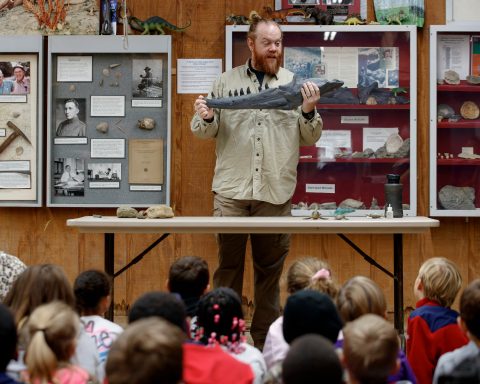
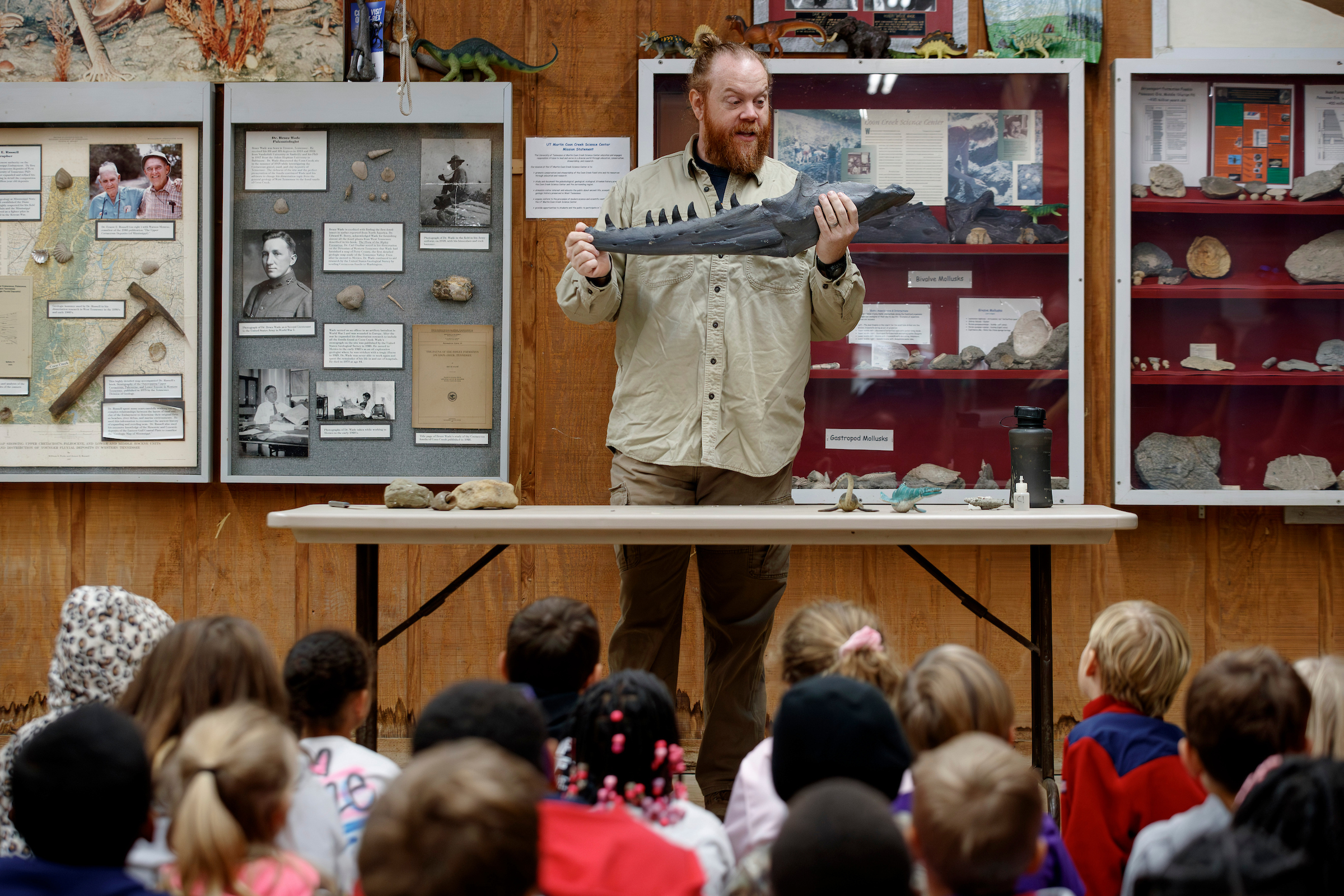
Because of the variety of sciences that are represented at Coon Creek, the site offers information and education on a wide scale. Ratliff said many elementary school students visit the site.
“In the Tennessee standards for teaching, fourth grade and fifth grade have a very big push for geology and paleontology,” he said. “So, for the last couple of years, I’ve had that age group come through with good hands-on science.
“You can read books all day long about going to dig dinosaurs, but most people are never going to get a chance to go dig on a dinosaur. However, you can go dig fossils here that were in the ocean at the same time the dinosaurs were walking on land.”
Coon Creek also hosts visiting scientists from across the United States and around the world, and students from other universities, including Vanderbilt and Tennessee Tech.
“They’ll bring their geology or paleontology students here,” Ratliff said. “If you come to West Tennessee, you can collect fossils from as far back as 430 million years ago up to 66 million years ago, all within an hour’s drive of this location.
Jonathan Mehr, the director of the UT Martin McNairy County Center/Selmer, oversees the operation of the Cook Creek Science Center.
“We just closed out a Grand Challenge grant in March,” he said. “It was only for a year, and we just extended it for another six months. With the help of that support, we serviced 3,584 elementary school-aged students during that time who were able to come and do a program at Coon Creek.”
The Grand Challenge Grants Program is an investment by the University of Tennessee System to fund transformative projects that improve the quality of life for Tennesseans. With up to $5 million dedicated to this initiative over the next few years, these grants support solutions in strengthening rural communities, overcoming addiction and advancing K-12 education.
The Coon Creek Science Center is more than a place for elementary and high school students to explore and learn. It can be a laboratory for college students at the UT Martin main campus or at its nearby regional center in Selmer.
“Coon Creek is more than a fossil site; it’s a launchpad for students’ careers,” said Erica Bell, executive director of Regional Centers and Online Programs. “We want a student’s first spark of curiosity here to grow into a lifelong career, and that path starts close to home. Local students can begin our geoscience and meteorology pathways right down the road at the UT Martin McNairy County Center/Selmer and through UTM Dual Enrollment and UTM Online.”
Visits to the Coon Creek Science Center are by appointment only. For reservations and general information about Coon Creek Science Center, call the UT Martin McNairy County Center/Selmer at 731-646-1636 or email cooncreek@utm.edu. Information about Coon Creek can be found at www.utm.edu/ccsc.
For more information about UT Martin, visit www.utm.edu or call 1-800-829-UTM1 (-8861).
PHOTO: This photo of a school visit in November 2024 shows Joshua Ratliff, the Coon Creek Science Center program director, holding the jawbone of a mosasaur found at Coon Creek for students to see.