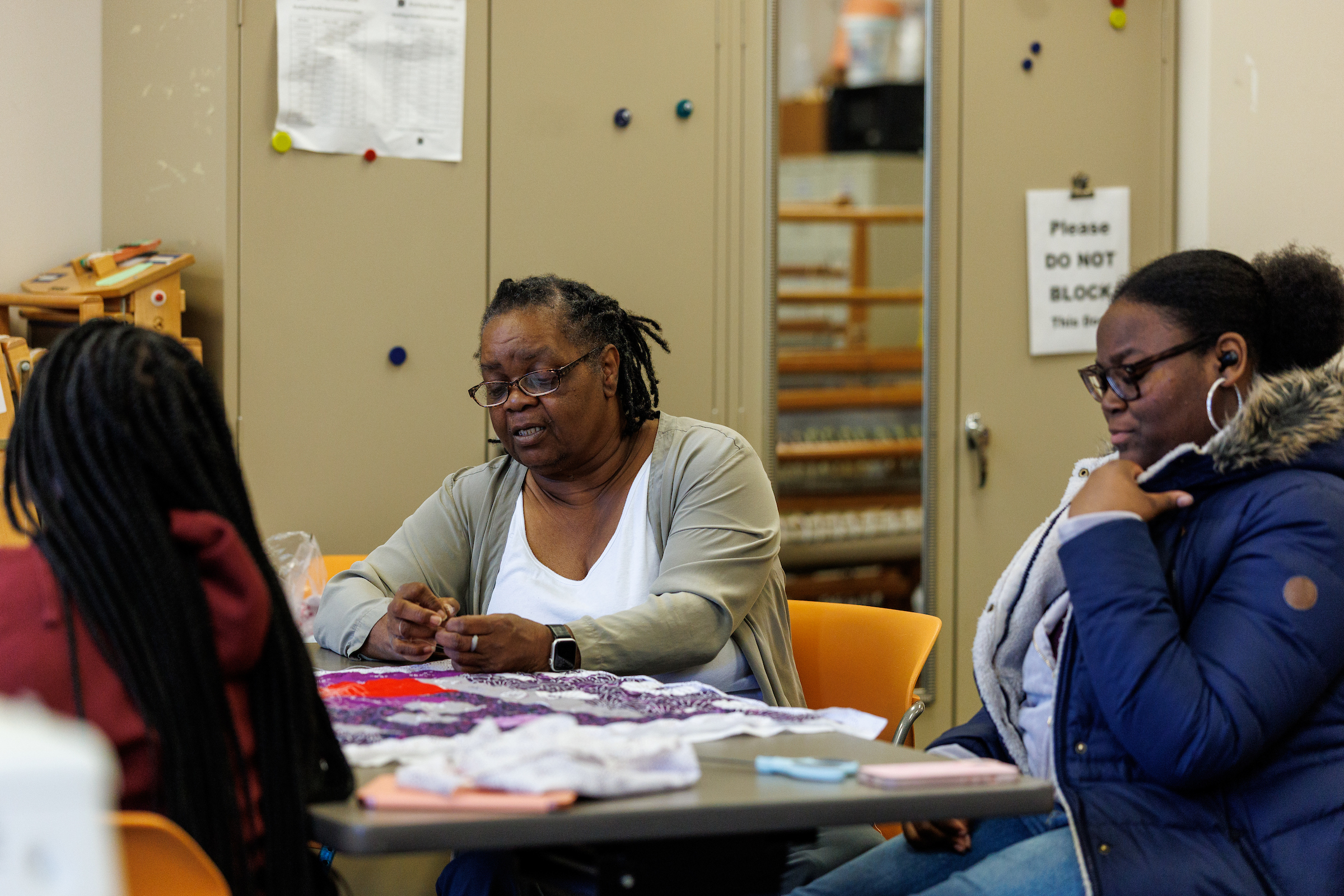
Mary Margaret Pettway, one of the noted Gee’s Bend quilters, was an artist-in-residence for a quilting class at the University of Tennessee at Martin for March 1-19.
Gee’s Bend is a community in Wilcox County in west-central Alabama in a bend in the Alabama River about 25 miles south-southwest of Selma, an area that includes the town of Boykin. Gee’s Bend is named for a landowner and slave owner from North Carolina who owned the land there.
The African-American families who lived on the land stayed there after emancipation, working the land to make a living. Many of the current residents’ ancestors took the surname Pettway, after the person to whom Gee relinquished ownership of the plantation in 1845.
The class, “Storytelling through Quilts,” was directed by Dr. Henri Giles, assistant professor of African-American studies.
Pettway taught and demonstrated quilting techniques, encouraging students through their growth in learning something new and telling them about Gee’s Bend and its history.
Giles said she sought an artist-in-residence for the unique experience that it brings to the students.
“It’s a different way of exposing students, and I wanted to have something like that at UT Martin,” she said. “So, for my Storytelling through Quilts course, I thought this would be a good opportunity for someone to come on campus and stay a little while, because quilting is a process.
“I wanted to bring the best, so I reached out to someone from Gee’s Bend, Mary Margaret Pettway. I had actually met her at the National Quilt Museum in Paducah, Kentucky, last year. I told her about my concepts for this course. She loved the idea, and she said she hadn’t ever been approached to do anything like that and, as far as she knew, none of the other women from Gee’s Bend had ever done anything like this before, either.”
Pettway said she has always enjoyed teaching, so when she was asked to be an artist-in-residence by Giles, there was no doubt.
“I was asked if I would consider (being an artist-in-residence), and the answer was always going to be a resounding ‘Yes,’” she said. “I’ve worked with a 3-year-old on up, including an 80-year-old lady.”
Pettway said the biggest surprise for the students in the class is discovering their own abilities.
“They are beginning to see that they made something with their own hands, their own mind – and it’s working. It looks nice,” she said. “They’re getting there – and I have told them already that I want them to make a second quilt. It’s not hard.
“I don’t want them to shy away because it’s a lot of work, because whatever you want, you’re going to work for it. So, I want them to know that it’s possible.”
Giles said the newness of the subject brought some trepidation for the students, but it also brought pride in their achievement.
“No one in this class had ever quilted before; they were all first-time quilters,” she said. “There was some hesitancy at first, but as they got into it and we went through the steps, you could see their confidence building.
“There were some mistakes where they had to undo some stitches or redo some of their work, but when they accomplished that, you could really sense that feeling of pride that they had in this quilt that they were creating.”
Pettway said she enjoys travel and has enjoyed the small-town life in and around Martin.
“I enjoy everywhere I go,” she said. “I’m not an outward person; you don’t have to worry to entertain me.
“I would love to (come back to UT Martin). Yes, I really would enjoy it. This is one town I do enjoy because it’s nice and it’s quiet. Everybody’s nice.”
Giles said she could tell that Pettway was enjoying herself in and around campus.
“She fell in love with the students, fell in love with the campus and the town of Martin,” she said. “She was able to get out and see the city and really enjoyed the small-town feel of it. She felt right at home here.”
Giles said that Pettway and the students hit it off immediately.
“Right away, she connected with them and they connected with her,” she said. “She quickly evolved from the role of artist-in-residence to confidante, grandmother – just someone who they developed these really good relationships with. It really was something to sit back and watch those relationships develop.
“Students deal with a lot, and I could see how they were opening up to her – discussing some personal things with her. Not only was she there to guide them through the quilt-making process, but she was someone they felt they could trust and talk to, and enjoyed having her in class.”
Part of Pettway’s instruction included a PowerPoint presentation about Gee’s Bend, featuring old photos of her relatives’ houses, an old ferry that crossed the Alabama River and quilts from almost 100 years ago.
Giles said there are benefits and advantages to having an artist-in-residence in the classroom.
“One of the benefits – especially in this instance – is being able to interact with someone who is regarded as the best in their field,” she said. “For people who are quilters and follow the women of Gee’s Bend, they know the importance of that. With UT Martin being able to bring someone of that caliber to this campus, I think it’s a benefit that students will probably talk about for years.”
When it comes to American quilting traditions, Gee’s Bend always comes to mind. Its residents have been making quilts since the 19th century, using creative and intricate patterns as a form of art or to tell a story.
Having a Gee’s Bend quilter as a guest is like having a living history lesson. Mary Margaret Pettway came to UT Martin to teach quilting techniques, but she taught so much more.
For more information about UT Martin, visit www.utm.edu or call 1-800-UTM1 (-8861).
PHOTO: Mary Margaret Pettway (left) of Gee’s Bend, Alabama – one of the noted quilters from that area – was an artist-in-residence at the University of Tennessee at Martin for three weeks in March. While teaching students like Terrah Edwards (right), a sophomore graphic design major from Memphis, she also spoke about the history of the central Alabama region, combining artistry with oral history.