A sixth consecutive fall enrollment increase, and sooner-than-expected four-year graduation rate progress were among the topics covered during the fall meeting of the University of Tennessee at Martin Advisory Board. The meeting was held Sept. 25 in the Boling University Center. Several reports and updates were provided to board members by university staff and UT Martin Chancellor Yancy Freeman.
Dr. Destin Tucker, assistant vice chancellor for enrollment management, reported fall enrollment at 8,253 students, the second-highest enrollment in university history, which brings UT Martin closer to its strategic-plan goal of 10,000 students enrolled by 2030. The highest university enrollment was 8,469 students in 2010.
While total enrollment numbers tend to receive the most attention, Tucker announced that UT Martin reached the university’s 2030 four-year graduation rate goal of 45% ahead of schedule. The four-year graduation rate stands at 45.23%.
“So, there’s still a lot of work to do, and we are going to continue to build on this progress, but this is a very important milestone for us,” she said. “It (the four-year graduation rate) reflects a lot of work across campus to help students stay on track and complete their degree.
“Our four-year graduation rate also positions us very well among regional comprehensive universities in Tennessee, which is something that we’re very proud of.”
Tucker said that the timing of four-year graduation rate improvement comes at a critical time, as formula funding for higher education in Tennessee shifts from a six-year to a four-year graduation rate. Retention is also monitored as an indicator of student success and tracks students who remain at the university to pursue their degrees. Tucker reported that the first-year retention rate this fall is 73.7% compared to a high of 77% for the 2023 cohort.
However, the university went from 736 students returning for their second year in 2021 to 974 this fall, which is a 32% increase in students continuing progress toward their degrees.
“Of course, we have had pretty large increases in our first-year classes over the past several years,” she said. “So, even though the percentage of our first-year retention has fluctuated, the actual number of full-time, first-time students returning for a second year has increased every year.”
Recruiting for the fall 2027 class is well underway with a goal of 5% growth, which would result in UT Martin’s largest enrollment in university history.
“But growth alone is not our goal,” Tucker told board members. “We want our students to succeed, and we are going to continue to invest in resources and infrastructure and policies that help students do that.”
In other advisory board reports:
• Dr. Steven Gentile, executive director of the Tennessee Higher Education Commission, was a guest presenter and explained Tennessee’s outcomes-based funding formula for higher education, which was implemented in 2011. The formula is shifting its focus on timely completion from a six-year to a four-year graduation measure. He also discussed new focused bachelor’s degrees that require no fewer than 90 hours to complete.
• Petra McPhearson, senior vice chancellor and vice chancellor for finance and administration, told board members that last year’s budget is expected to be closed by mid-October and then previewed the FY’26-27 budget. She reported a net increase in state appropriations of $200,000. A $2.8 million budget reallocation will occur in September and October to offset a decrease in performance funding and cover university investments in areas such as salaries, benefits, scholarships and fee waivers.
• Jeanna Curtis-Swafford, vice chancellor for university advancement, provided fundraising updates and alumni relations activities, including a record-breaking Captain’s Challenge in April that raised $692,572 from 1,959 donors. She reported a total of 5,870 donors in 2025-26, which was the highest ever for the university. Alumni Relations also contributed to university engagement with coordination of UT Martin’s yearlong 125th celebration, which recognized UT Martin’s founding as Hall-Moody Institute in 1900.
• Jake Bynum, chief of staff, provided a 2025-2030 UT Martin Strategic Plan status update, which included both areas of progress and a preview of coming initiatives. Examples of progress noted were 1,400 identified external university partnerships compared to 56 baseline partnerships when strategic plan work began. Four targets were met, and those target ceilings will be raised to include stretch targets. Projected strategic plan initiatives for this fall and spring 2027 include the launch of new advisory councils, a new student-advising structure and announcement of the first Skyhawk Summitt Awards, which recognize outstanding UT Martin students, faculty and staff.
• Chancellor Yancy Freeman closed with a brief preview of a new economic impact study conducted for the University of Tennessee by Lightcast, a global labor market intelligence firm. The project included studies for all UT campuses, and a $456 million economic impact was identified by the study for UT Martin, which means $456 million in economic activity that would not have occurred without the university. Freeman said that more detailed information about the study will be released in the future.
Also, President’s Award recipients from UT Martin were introduced to the board during the meeting. The awards were based on outstanding accomplishments and service to the university. Receiving 2026 awards were:
• Ashley Bynum, senior associate athletics director for internal operations, “Nimble and Innovative” category;
• Dr. Steve Elliott, professor and chair, Department of Mathematics and Statistics, “Bold and Impactful” category;
• Dr. Adnan Rasool, associate professor and director, Center for Teaching and Learning, “United and Connected” category; and
• Alicia Maya-Donaldson, professor and chair, Bachelor of Science in Social Work Program, “Embrace Differences” category.
Receiving a President’s Award from the UT Foundation Inc. was Matt Borden, UT Martin director of annual giving.
Advisory boards were created for each University of Tennessee campus under the UT FOCUS Act passed in 2018 during Gov. Bill Haslam’s administration. Board members are appointed by the governor, confirmed by the Tennessee General Assembly, and advise the chancellors, UT president and UT Board of Trustees on matters related to the university campuses.
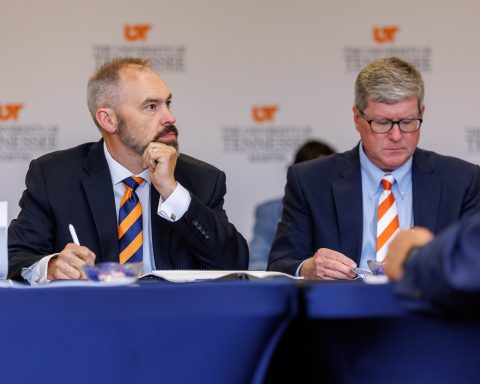
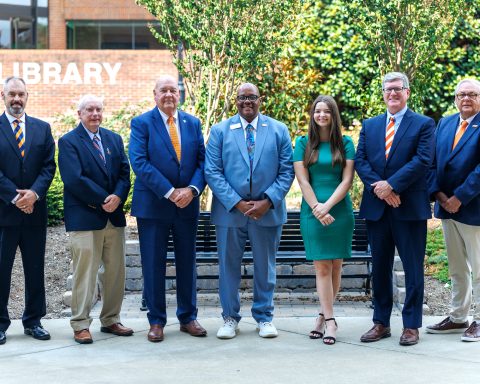
Current UT Martin Advisory Board members are Hal Bynum, Dresden, current chair; Jennifer Hampton, Martin; Leah Repp, student representative, Madison County; Dr. Sandy Mehlhorn, faculty representative, Martin; Stefan Maupin, Dyersburg; Alec Richardson, alumni representative, Nashville; and Dan Strasser, alumni representative, Chapel Hill.
The full board meeting will be archived for viewing at www.utm.edu/abmeeting. The UTM Advisory Board’s next meeting will be Jan. 22, 2027, in Martin.
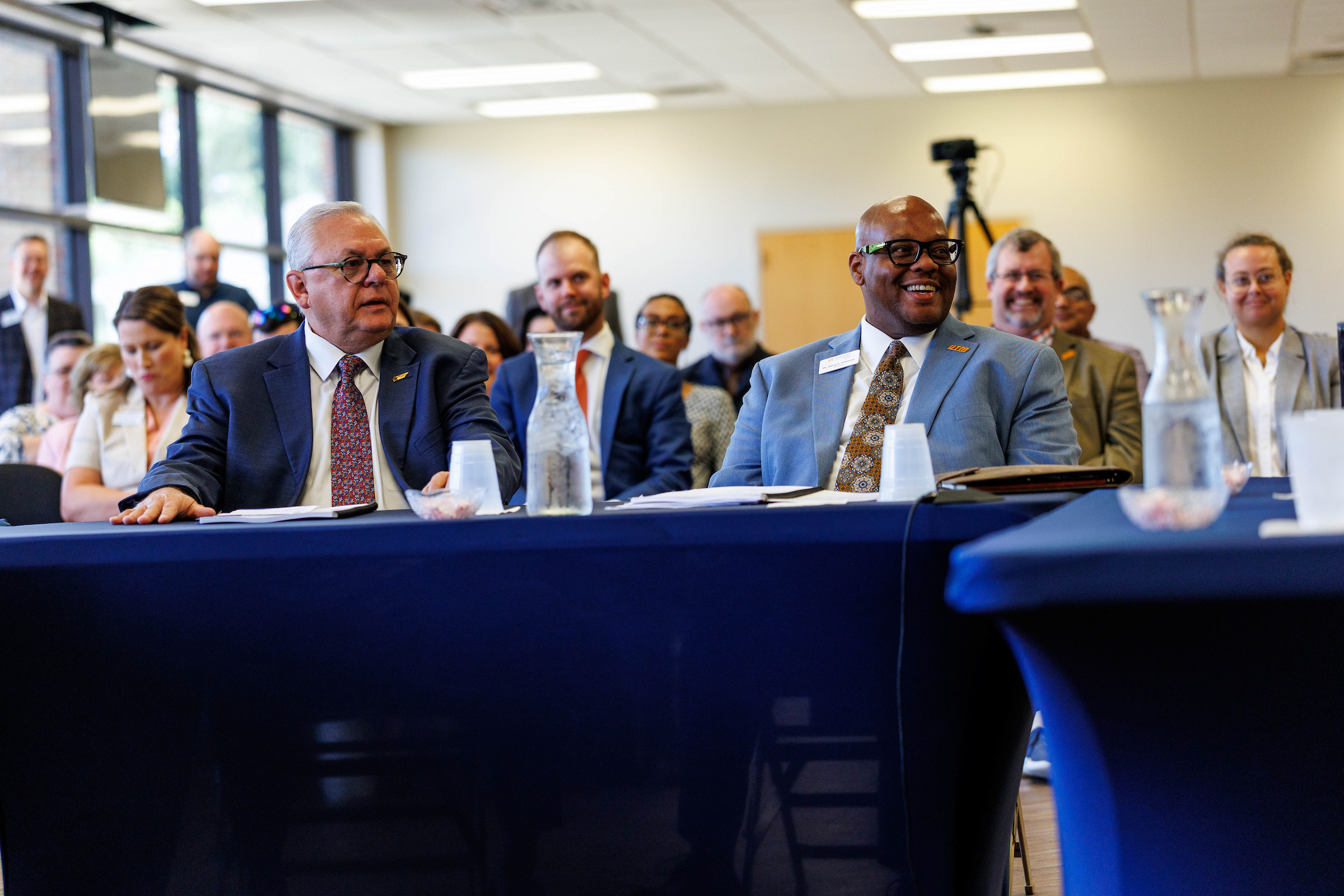
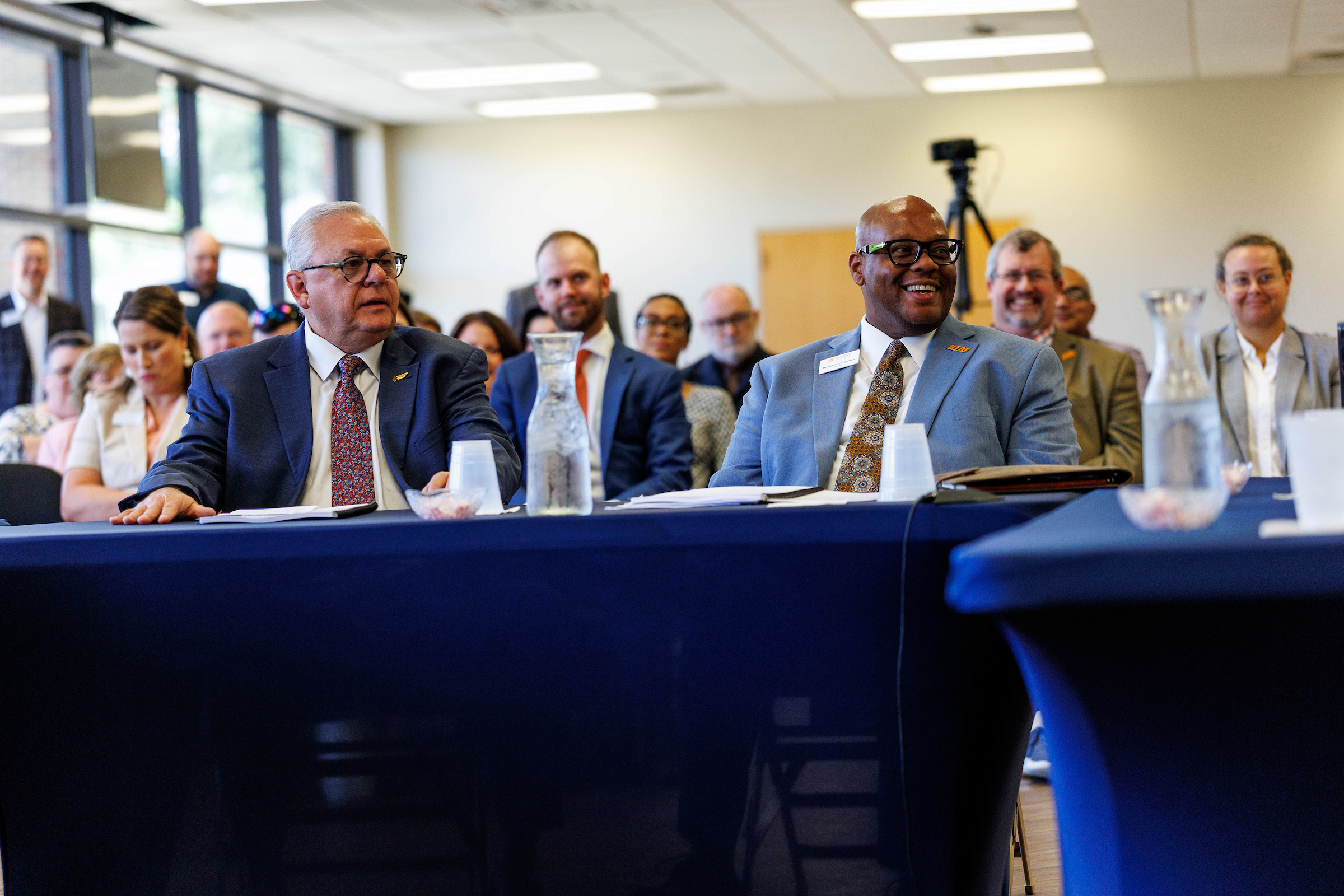
PHOTO: The UT Martin Advisory Board met Sept. 25 for its fall meeting in the Boling University Center. Pictured during the meeting (l-r) are Hal Bynum, board member and chair, and UT Martin Chancellor Yancy Freeman.